Here Come The AI Teaching Bots

A recent EdTech Magazine article advocates for the rise of AI in the classroom. Often dubbed “bots” in social media circles, these subtle software programs use algorithms to help teachers measure student performance.

The article marks the inevitable use of AI and bots in the classroom. The education AI movement extends beyond the edtech sector and includes some of the industry’s biggest content providers, like McGraw-Hill.

Uses for AI extend across diverse subjects and tasks. Whether it’s assessments or grading, or recommending next levels of content, AI can help a teacher make smart decisions about how to guide a student and/or a classroom.

Of course, the EdTech Magazine article closes with an almost mandatory, semi-comforting phrase: “We will always need teachers and human interaction in the classroom. Anything else does not compute.”

But if that’s the case, how does AI work with a teacher in the classroom?

Rise of the AI Teacher Advisor

IBM launched its Teacher Advisor with Watson AI program to help educators. The program was developed in partnership with the American Federation of Teachers.

With tests in more than 1000 classrooms, the program aims to save elementary school teachers time through formative assessment, lesson planning, and other actions. In essence, Teacher Advisor is the digital equivalent of a teaching assistant.

We like AI teaching tools like this because we know how overburdened teachers are, particularly public school teachers. Whether they have 30 students in elementary school or 120 in high school, personalizing lessons for individual students or small cohorts is challenging.

That is particularly true not just with class and non-class hours, but also during personal time. Teachers are spending as much as five to seven hours per week just looking for new and interesting content. Then they have to assess, integrate, and launch this content. Not to mention their actual grading and teaching work.

If we consider any relief or assistance to be useful, AI can make a teacher’s life much more reasonable.

But can it replace a teacher? Isn’t that the great fear?

The Diamond Age AI Lesson

Neal Stephenson’s cyberpunk classic The Diamond Age picks up this very subject. In the book, three young girls are all given the same nanotech primer to help them learn and understand subjects as well as life skills.

How does the AI primer work out for these girls? As you might expect, it works very differently for each individual student.

In fact, it doesn’t matter that the AI alters itself to meet the students’ needs. The students are unique and make different decisions based on their perspective.

While educational, the primer cannot coach the girls well or help them change their life perspective. In some ways, The Diamond Age illustrates the failure of technology to influence our humanity.

In the end, teaching is more than imparting knowledge to students. A teacher delivers a very real human perspective, either intentionally or through abstract experience. When given the time to focus, teachers perceive a student’s needs, needs that may not be expressed through performance data.

AI may never replicate this human interaction, which may explain why we will always need a teacher’s perspective.

What do you think?

7 Go-To Sites for Science Resources

Teachers like you are constantly searching for new science resources and content to diversify their lessons and engage students.

Browsing the internet is a great way to find science resources, but with so much content available, it’s easy to spend hours searching. In fact, some teachers dedicate five to seven hours a week just to finding the right materials.

If you’re looking for more than just games, start your search here. These seven curated sites can help streamline the process and guide you to quality resources faster.

1) Share My Lesson

Share My Lesson is a fantastic database of science resources, featuring lessons from early childhood through high school. As the name implies, teachers log on and share their own lessons and resources. To date, those total more than 420,000, including more than 11,000 for middle school science alone! They’re all free, and searchable by grade and standards.

2) Teachers Pay Teachers

You’ve probably heard of Teachers Pay Teachers by now. Much like Share My Lesson, TpT hosts lessons crowdsourced from educators. Boasting an even bigger library of more than 2.8m resources, some free and some paid, it’s a fantastic tool for bringing together the genius of teachers everywhere. When you’re searching, you can sort by grade, subject, resource type, and price, or check out the trending topics on their homepage.

Teachers Pay Teachers hosts science resources for teachers everywhere.

3) University of Cincinnati Libraries

The UC Libraries STEM Education page links to a bunch of juicy STEM content across the web. These include science websites, lesson plan libraries, student research databases, educational videos, curriculum resources, and much more. Dig into this wealth of material, vetted by a major research university.

4) Teaching Ideas

Teaching Ideas is a British site that lists an eye-popping amount of resources for teachers. Along with science, teachers can find inspiration for English, “maths” , computing, art, music, history, PE, you name it — so go ahead and share it with your non-science colleagues! If you’re looking for lesson plans, projects, videos, or games, it’s all here, with a search functionality and many levels of filtering.

5) Tes

Tes is an education giant, claiming “the world’s largest online community of teachers” with almost 8 million registered users. Like Share My Lesson and TpT, Tes hosts a marketplace where teachers can share all kinds of resources, free and paid, from pre-K through high school. Their marketplace also features a bunch of discussion forums, as well as resources for exploring the teacher job market (focused on the UK). They also publish a magazine, and publish tons of education-related news. Talk about a go-to education site!

Tes has thousands of science resources, from lesson plans to news articles.

6) Legends of Learning Science Games

Legends of Learning is an award-winning game-based learning platform designed to boost student engagement and improve test scores through interactive, curriculum-aligned science games. With a library of over 2,000 expertly crafted games, teachers can seamlessly integrate engaging, standards-aligned content into their lessons—whether in the classroom or at home.

Every game on the platform is carefully selected based on user reviews and educational value, ensuring a balance of fun and learning. Designed to captivate students, support teachers, and empower districts, these games make science more accessible and enjoyable.

Ready to explore the best of the best? Here are 10 top-rated science games that combine immersive gameplay with real learning outcomes, helping students grasp complex scientific concepts while having fun!

7) Carl Wieman Science Education Initiative

Out of the University of British Columbia, CWSEI mainly focuses on research related to science pedagogy in higher education. However, their site lists a wide variety of resources, including tools that can be used in the classroom, but also a plethora of reference books and articles for everything you want to learn about education. The Initiative’s stated goal is to build “a more scientifically literate populace… able to make wise decisions, informed by scientific understanding, about other complex issues” — a mission we can all get behind!

If you’re looking for new science resources, this list is a good place to start. These websites complement the depth and breadth of the thousands of science games and assessment items teachers find on the Legends of Learning platform.


Don’t miss out on our latest posts!

Legends of Learning Wins Amazon Startup Challenge

Earlier this month, Legends of Learning took home first prize at the Amazon Web Services EdStart “pitch day” in New York City. AWS brought in ten EdTech startups to present their products in front of over 100 industry leaders. Legends of Learning Founder Vadim Polikov and Co-Founder Josh Goldberg made the trip to Manhattan.

In a five minute presentation, Vadim and Josh showed attendees the look of the LoL platform and detailed our standards-based approach and commitment to equipping teachers with detailed data analysis. They fielded questions and took feedback from fellow EdTech experts, who submitted collective scores for each of the presenting companies. The audience was very impressed with the Legends pitch, ultimately awarding the company first place!

There were several other companies present. One company, Cell-Ed, presented their mobile software for teaching adults basic skills they need for the workforce, and won third place. Another, Learnmetrics, took second place when they showcased their powerful learning analytics tool designed to bring out the full potential of students and their schools.

Our team came back to Washington, DC with a few prizes and more than a few ideas for how to keep improving Legends of Learning for students and teachers. They were inspired by all of the bright minds around them, who share the goal of improving education for learners everywhere.

We would like to thank Amazon Web Services for hosting the AWS EdStart pitch day, and supporting Legends of Learning. You can read more about the event on their blog.

Five Reasons You Should Teach with Games

Adults love games. Kids love games. Both groups of people work in classrooms. So why aren’t classrooms filled with game-based learning? Keep reading and discover the five key reasons to teach with games!

Some teachers have resisted gaming because they see it as a chance for students to goof off rather than focus. In their minds, games do not truly teach content and thus do not provide educational value.

Over the past few years, learning games have evolved to include content of real value. Meaningful learning games are now easily accessible for teachers. Legends of Learning offers 900 science curriculum games for middle school.

Take it from this teacher. Game-based learning is not only fun for students it makes teaching easier.

Five Reasons to Use Games in Your Classroom

1. Students Love Games – Most students already spend free time playing games online with friends, watching other gamers play on YouTube, and bragging to each other about who’s the best gamer.

Introducing games into your class is a natural extension of what your students already like. With so many games available that teach content, it’s the perfect fit for your classroom.

2. One-on-One Time with Students – Imagine getting to walk around a room of 30 students and having meaningful one-on-one conversations with each of them. Because students are so engaged, off-task behavior with gameplay is minimal, in turn giving you time to work with the students who need your help most.

3. Curricula Games Mean Learning – Games are effective because students have so much fun playing the games they don’t even think about whether learning is taking place. When students are engaged, they learn significantly more content and remember more of what they learned. This leads to higher test scores and more confidence in taking on complex tasks in the classroom.

4. Struggling Students Feel Included – When students struggle, they often stay quiet or act out. Because games are fun and teach content without shame, struggling students engage and learn at their own pace.

It’s common to see organic conversations about content crop up during class. Students who never raise their hands show eagerness to participate. Games remind you that all students want to learn, they just need the right vehicle.

5. Personalized Learning – Games let students take control of what they learn. Students teach themselves new material or review existing knowledge via engaging gameplay. Teachers facilitate learning, gently guiding students through game play, and helping them think critically about decision points. This is the 21st-century classroom.

As you consider your lesson plans for the school year, imagine the possibilities games offer as an everyday part of your instruction. Simply put, game-based learning can transform your classroom. Want proof? Try Legends of Learning science games for three weeks and watch student achievement take off in your classroom.

Aryah Fradkin is Manager of Teacher Outreach and Engagement for Legends of Learning. Before joining the Legends, he taught middle school for six years in Baltimore City Public Schools.

Summer Learning Day: $300 Game Trial

National Summer Learning Day is just a month away! What are you doing to celebrate? Legends of Learning is extending its $300 trial offer until July 13 to help teachers and students better enjoy summer learning.

Students enrolled in summer class need a break from the daily routine, and Legends of Learning middle school science games are a great tool. Games offer kids an opportunity to enjoy summer school a little more, while simultaneously improving subject mastery. Original research backs up the impact of games!

Summer is a critical time for students to stay on track and close achievement gaps. Strengthening learning programs can give districts, teachers, parents, and students a much-needed boost. For more information, check out our summer learning white paper.

The National Summer Learning Association reports most families not participating in a summer program say they would if one was available, but the average cost of these programs is $288 per student per week.

As part of its launch, Legends of Learning provided teachers who signed up on its platform $300 worth of edgames for free. After July 13th, initial trial coins will be reduced to $100 for free.

Sign up for free games today!

Legends of Learning in the News

1. District Administration – Science-focused platform and game content to be released
In March 2017, Legends of Learning released its educational games (edgames) platform in 100 middle schools across the country. The games meet the standards for middle school science curricula, and CEO Vadim Polikov conducted a 1,000-student study in partnership with Vanderbilt University to demonstrate the games’ efficacy and ability to engage students.

Polikov will facilitate additional surveys and studies to provide more evidence in support of the Legends of Learning methodology in the near future. He explains, “Educators’ time is at a premium now, so providing them with something that is demonstrably effective and easy to use has a far greater chance of being implemented.”

But don’t take his word for it. Talk to one of the hundreds of teachers in the Legends of Learning Ambassador program, or better yet, start using the platform and become an Ambassador yourself!

2. DC Inno – Oregon Trail-Inspired Startup Wants More Video Games In Schools
“Who would’ve thought that one day Oregon Trail would inspire someone to start a company?” asked Samantha Sabin, staff writer at DC Inno. She was amazed at how Legends of Learning co-founders Josh Goldberg, Geoff Livingston, and Vadim Polikov formed their educational technology (EdTech) company.

The three men hypothesized curriculum-based edgames could engage kids in learning, and tested the theory in conjunction with Vanderbilt University researchers prior to establishing the company. The study showed vast improvements in test scores for students who played the games. Once the results were in, Legends of Learning launched their edgames platform in March 2017.
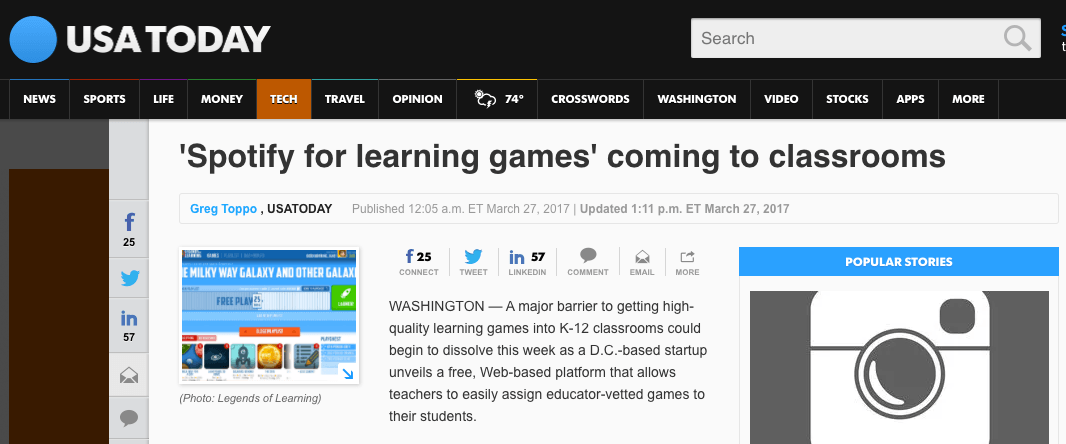
3. USA Today – ‘Spotify for learning games’ coming to classrooms
On March 27, 2017, Legends of Learning launched its edgames platform, an easy-to-use interface featuring 900 middle school science games for today’s classrooms. The company calls the platform “Spotify for learning games.”

Game developers, or “artists,” create standards-based games for “listeners”—teachers, administrators, and students. Teachers can earn free access to the platform in exchange for providing the developers with feedback.

Additionally, schools can pay about $10 per student for a learning management system (LMS) that measures student progress in the games. USA Today calls the platform “an all-you-can-eat menu of games,” and teachers like Rebecca from upstate New York agree – students playing the games are hungry to learn!

4. Getting Smart – Innovation in Education Is More than a New Approach
CEO Vadim Polikov writes that Legends of Learning brings a new strategy to education innovation: academic research. He hypothesized that edgames could improve student engagement in the classroom and put the theory to the test with help from Vanderbilt University.

The study provided Polikov with the evidence needed to establish Legends of Learning, a company that provides an online edgames platform that teachers use to bring games into their classrooms. Polikov’s work also contributes to the broader academic literature, with potentially massive implications for the future of education.

Another huge point of emphasis is ease of implementation. With an idea like this, Polikov says, “When it is easy and obvious, the barriers to widespread acceptance are much lower.” Legends of Learning achieves this with its intuitive platform, which is easy to use for students and teachers alike.

5. WTOP – DC startup Legends of Learning aims to be ‘Netflix’ for educational games
Legends of Learning provides all the ease and entertainment of Netflix and Amazon with its online edgames platform, amplifying productivity, engagement, and learning in the classroom. The platform hosts 900 games and counting, all of which are based on curriculum standards – NGSS, TEKS, SOL, and more.

The Legends of Learning platform is free for teachers as long as they provide feedback to help developers improve the games. Schools have the option to track student progress for a low-cost subscription fee.

6. EdTech Mag – Q&A: Vadim Polikov’s Startup Brings Game-Based Learning to Science Class
EdTech Magazine asked CEO Vadim Polikov what inspired him to form Legends of Learning, an EdTech company that provides curriculum-based games for classrooms across the country. He replied with his own childhood experience, stating, “To this day, I don’t remember what I learned in eighth-grade history, but I am a history buff because I played Civilization.”

Polikov’s background as a research scientist led him to explore why the game impacted him so. He partnered with Vanderbilt University to assess how edgames affected students and learned that games truly do, qualitatively and quantatively, increase engagement and test sores.

7. Baltimore Sun – Legends of Learning raises $9 million for expansion
In April 2017, DC- and Baltimore-based EdTech startup Legends of Learning announced it had raised $9 million from investors, including the Baltimore Angels. Legends of Learning will use the funds to expand the platform and related services, such as analytics and tracking. The company will also add employees to grow its library of games into other school subjects and grade levels and to serve more schools.

8. Baltimore Business Journal – Former Astrum Solar exec raises $9M for edtech startup
Legends of Learning, a new EdTech startup in Washington, D.C. and Baltimore, closed a successful seed funding round totaling $9 million. The company offers an online platform for edgames – 900 of them, so far – supporting the middle school science curriculum. The seed money will be used to expand into other subjects and grade levels and to hire new company employees.

9. Potomac Tech Wire – “Today’s top story: Edtech Startup Legends of Learning Raises $9 Million in Seed Round”
A DC- and Baltimore-headquartered startup, Legends of Learning, reported $9 million in seed funding for its online education games platform. The platform features 900 games across the middle school science curriculum. The seed money will allow the company to expand into more grades and subjects, as well as conduct additional studies on game-based learning and its impact on student engagement and achievement.

10. DC Inno – The DC Inno Beat: NEW MONEY
Legends of Learning, a DC EdTech startup that offers learning games based on Next Generation Science Standards (NGSS), is poised to grow. Thanks to a strong $9 million round of seed funding, the company will grow its staff from 14 employees to 30. It will also develop games for other grade levels and school subjects.
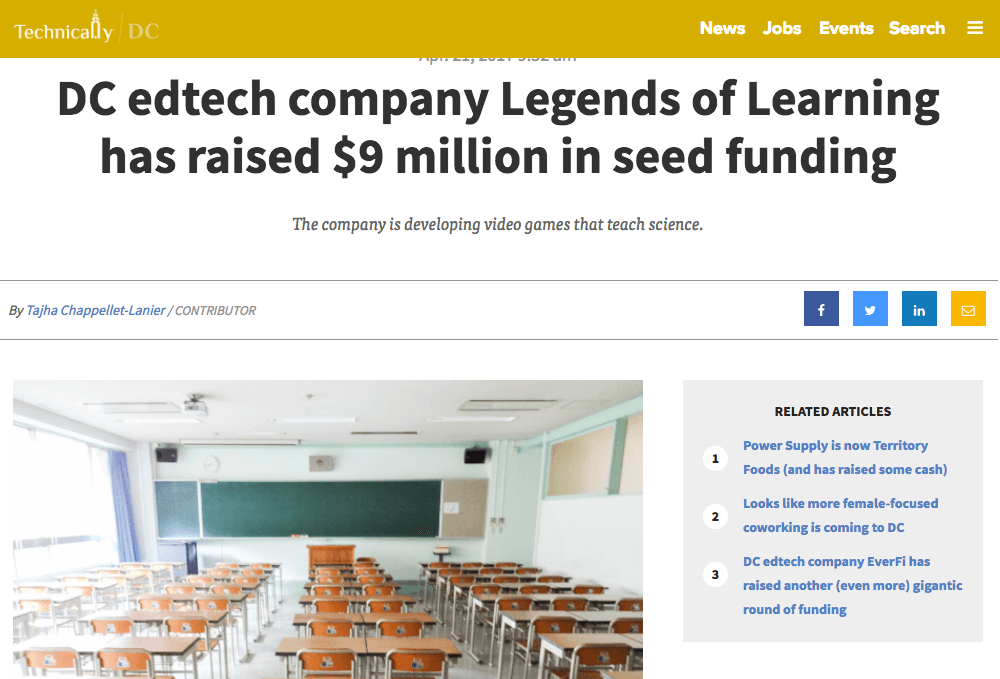
11. Technical.ly – DC edtech company Legends of Learning has raised $9 million in seed funding
In March 2017, EdTech company Legends of Learning released its online platform containing 900 middle school science games for the classroom. At the same time, it raised $9 million in seed funding. The funds are earmarked for growth; the company will be hiring new employees in the spring and summer to expand into subjects across all K-12 grade levels.

12. EdWeek – Do Digital Games Improve Children’s Math Skills?
Students in Florida’s Hillsborough County schools are showing improvements in math after using classroom games such as TiViTz. In addition to higher achievement, teachers are reporting increased enthusiasm among students playing these edgames.

A 2014 study showed that nearly three quarters of K-8 teachers nationwide are using digital games in their classrooms. Related studies, like the one conducted by Legends of Learning founder and CEO Vadim Polikov, have demonstrated strong positive correlations in student achievement – and enjoyment – with the use of digital edgames.

13. EdWeek Market Brief – K-12 Dealmaking: EVERFI Raises $190 Million; Legends of Learning, Marco Polo Raise Funds
Legends of Learning, a new edgames company that launched in March 2017, raised $9 million in its most recent round of seed funding. The company brings research-driven, curriculum-based games to schools.

Its 900 games cover a variety of middle school science topics. With the new funds, Legends of Learning will expand to more subjects throughout K-12 curricula.

14. EdSurge – New Research Proves Game-Based Learning Works—Here’s Why That Matters
In order to successfully implement game-based learning (GBL) in classrooms, edgames must engage students while also supporting curriculum standards. Prior to founding Legends of Learning – an education startup with a curriculum-based GBL platform – Vadim Polikov led an academic study with Vanderbilt University researchers to determine the efficacy of the company’s approach.

The study found that students who played edgames were more engaged in the classroom, and performed significantly better on standardized tests, than those who didn’t play. Polikov has a second, larger study in the works to continue to examine the efficacy of GBL. Research like this is critical in adopting of new, innovative techniques in the classroom, and advancing education in America.

15. EdSurge – How to Roll Out Game-Based Learning—and Boost Engagement—in Your Classroom
Before launching Legends of Learning, an EdTech startup that provides GBL content for classrooms, CEO Vadim Polikov teamed up with researchers at Vanderbilt University to conduct a control study with more than 1,000 8th grade student participants. Students who played the edgames demonstrated stronger understanding of classroom subject matter and scored higher on standardized tests than those who didn’t play. Teachers also reported that students – including those who were normally less engaged in class – had more organic conversations about the subject matter while playing, and had fun doing it!

16. EdSurge – Classroom Gaming Should Be Engaging, Tied to Curriculum—and Not Require Teachers to Code
In order for edgames to be effective, they must be easy for teachers to implement. This can only happen when the games supplement lesson plans with engaging, curriculum-based content.

New education startup Legends of Learning focuses on efficacy, delivering easy-to-use games that adhere to NGSS curricula and fit into short class periods. Before founding the company, Vadim Polikov partnered with Vanderbilt University researchers to conduct a large-sample control study.

The results were promising for both teachers and students, and led Polikov to launch Legends of Learning in March 2017. The company’s platform hosts 900 edgames, and teachers who use it say students are showing improved classroom engagement and better grasp of difficult concepts.

Legends of Learning Closes Seed Round as Product Launches to Enthusiastic Reviews


$9 Million Raise to Support Team Growth, Market Expansion


The following is a press release issued this morning about Legends of Learning’s seed round of fundraising.

Legends of Learning closed its seed round of fundraising with a total raise of $9 million. The fundraising round follows the successful launch of our initial game-based learning platform that has been met with praise from educators and recognition by influential media organizations. The company was featured in a recent USA Today article that explained how its platform can overcome a barrier to “getting high-quality learning games into K–12 classrooms.”

Legends of Learning, which is co-headquartered in Washington, D.C. and Baltimore, Md., will leverage the funds to execute its long-term strategic plan in the education sector. The investments will allow the company to meet demand by hiring additional team members and expanding its platform to new school grades and subjects.

The company was founded by Vadim Polikov, a research scientist who previously started Astrum Solar, a top 10 U.S. solar installer, and American Journal Experts, a large academic editing company serving the international scientific research community.

Joining Polikov as co-founders are Larry Cynkin, chief technology officer, who was formerly with Comcast and Honesty Online; Aryah Fradkin, manager, Teacher Outreach, who is a former Baltimore City, Md., teacher; Joshua Goldberg, chief strategy officer, and an Astrum Solar co-founder; Geoff Livingston, chief marketing officer, who is an award winning digital marketing entrepreneur; and Sandy Roskes, chief operating officer, and a former Astrum senior executive.

“This team brings vision and experience to the table. The successful closing of this seed round will let us accelerate our focus on helping more teachers reach students with research-driven, curriculum-based education games,” says Polikov.

Legends of Learning launched at the end of March with a first-to-market approach of 900 curriculum-based education games for middle school earth and space science, life sciences and physical science curricula. The games, created by over 300 game studios, are based on rigorous academic research conducted in partnership with Vanderbilt University.

Unique aspects of the Legends of Learning game-based learning platform include:

  • Short games (5–25 minutes) that align to middle school science curriculum standards to ensure content engages and helps students succeed in their studies;
  • An intuitive platform similar to Netflix and Amazon that makes games easy and natural to use in classrooms; and
  • A dashboard that allows teachers to observe student comprehension in real time, create game playlists for classes and individual students, and assess content mastery.

The company will demonstrate its technology platform and games publicly at the International Society for Technology in Education Conference & Expo June 25–28 in San Antonio, Texas.

Chris Aviles on the Ethos of Game Based Learning

Chris Aviles is a teacher in New Jersey who is actively bringing game based learning to schools. He describes himself as http://www.techedupteacher.com/about-chris-aviles/

Game based learning is an ethos, not a tool that you buy, said Chris in our podcast. Still we pressed him for some recommendations. He also shared his insights about smartphones in school, and why banning them is a mistake.

Also a blogger and thought leader online, too, Chris is a great follow. Be sure to check out his profiles and chat with him.

31 Game-Based Learning Resources for Teachers

Game-based learning (GBL) resources offer proven benefits for student engagement and academic performance. But convincing some educators to include GBL resources in their curriculum can sometimes feel like a clash of the titans—the teen kind, not the ones who dared to defy the Olympian gods.

(more…)
For Teachers
For Schools
For Districts